In order to produce innovative fuels from regional residual materials, suitable biogenic feedstocks must first be identified in sufficient quantities. The Sulzbach-Rosenberg branch of Fraunhofer UMSICHT is therefore systematically investigating the potential of various waste and residual materials such as biowaste from household collection bins, municipal sewage sludge, or wheat straw. The aim is to provide reliable material streams for the technologies used in the project: Thermo Catalytical Reforming (TCR), Enhanced Power-To-X-Output (EXO), and fermentation.
Based on literature research and expert interviews, the theoretical (see related press release in 2025 here), technical, and mobilizable potentials of these residual materials were determined. The analyses show that very large theoretical potentials are available in Germany overall.
For an exemplary 30 MW plant with 10 MW assigned to each route (TCR, EXO, and fermentation), approximately 19,000 megagrams (Mg) of dry matter (DM) biowaste, 22,500 Mg DM sewage sludge, and 15,000 Mg DM wheat straw are required annually. While wheat straw generally proves to be uncritical, the secure provision of biowaste and sewage sludge can be challenging. However, the investigations show that regions with high population density, well-developed biowaste collection systems, and high-performance wastewater treatment plants offer good prospects for economically viable supply. Additional residual materials such as oversize screening fractions from composting, digestate, or other suitable biogenic material streams can also be integrated. In this way, a flexible feedstock concept is created (for exemplary feedstocks, see the figures below) that can be adapted to regional conditions while at the same time meeting stringent sustainability requirements.
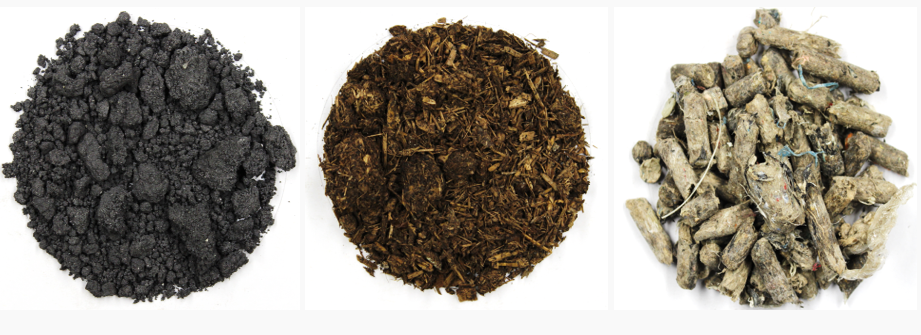
With this work, Fraunhofer UMSICHT provides an important basis for planning SynergyFuels plants in locations where sufficient suitable biomass is available – and demonstrates that previously underutilised residual materials can make a substantial contribution to sustainable fuels of the future.